Drying timber
Unlike firewood, it is generally undesirable to dry cut timber quickly.
Force drying timber will usually lead to exaggerated end splitting, checking (surface splits), warping and cupping.
Quick drying can be achieved in a controlled kiln environment, but most people will not have access to this and in the non-commercial world, this would usually be uneconomic. The alternative is air-drying which is what is discussed below.
We can advise on drying strategies for you, when engaged, but in summary:
Siting is important; the stacks need to be out of direct sunlight with air able to move freely around and through the stacks. An airy barn is ideal. Direct sunlight will tend to force dry the area it strikes and give rise to uneven drying.
Base bearers should be spaced arond 45cm/18" apart on level ground or a levelled base frame.
Each layer should be separated by wood batons - usually referred to as stickers. These should be dry wood around 2-2.5cm/1" square and be long enough for the full width of each layer. Air must be able to move freely through the layers, preferably from side to side rather than end to end. Side to side will mean the timber will dry more evenly.
Stack evenly.
Add weight to the top.
If outsideCover with off cuts or roofing sheets.
There is debate regarding painting the ends of the cut timber with some form of sealing medium (latex paint, PVA or any other paint), to prevent/reduce end splitting. We have not undertaken any controlled scientific experiments on the matter, so will refer you to the internet to satisfy yourself whether this is worth doing or not.
Straping of boards can be helpful to reduce cupping (boards bending width-ways) - where a set of ratchet straps can be employed to go around the stacks at multiple points. Important to monitor this and check the straps are tight, but not causing additional undesirable bending.
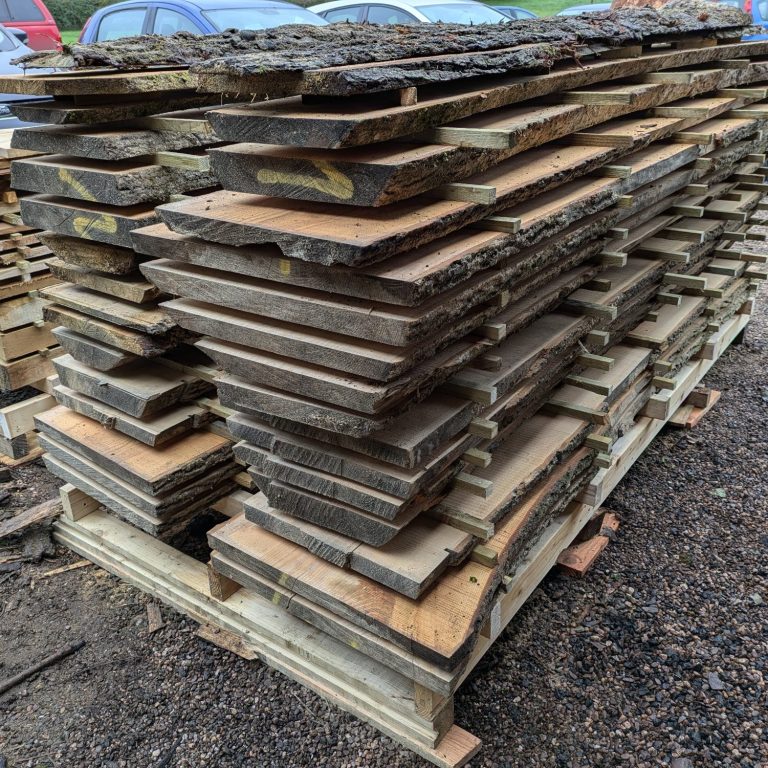
A nice stack...
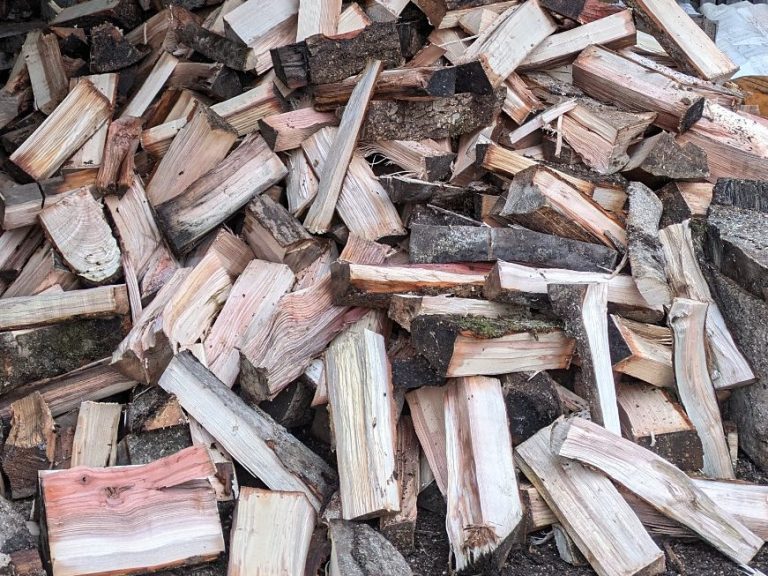
Drying firewood
General myths:
- You can burn ash green (in theory you can burn anything green…eventually, but you will use all your other dry wood to heat it up, dry it and then combust it in your log burner!).
- Leave the logs in the wood for 12-18months and they’ll be seasoned for burning (no, they’ll be wet and full of rot unless they’re oak, in which case they will be just as unseasoned as when you cut them down!)
- You need to leave the logs 2 years before you can burn them (nope, not necessarily all dependent on drying strategies – see below)
- etc…
There are 2 books I’ve found to be my go-to books on the matter:
Home Heating with Wood (now out of print), but available 2nd hand on that website site where you can buy most things (ISBN-10 - 1902175271). Some parts are slightly out of date now, but still a very useful technical book with plenty of info that won’t go out of date. This is a book from those great folks at The Centre of Alternative Technology (CAT – look them up at https://cat.org.uk).
And
Norwegian wood by Lars Mytting (ISBN-10 – 0857052551). Just a great book on the obsession of the whole wood thing and both entertaining and technical enough to be a great read.
There are plenty of others out there all good in their own way, but these are the two I keep coming back to.
From my own experience and having read these books (the CAT one in the first instance and Norwegian Wood after years of my own experimenting) I think firewood drying comes down to a few simple fundamentals:
- Cut the wood and split it as soon as you can after you cut it down. Don’t leave it in the woodland to season…it doesn’t.
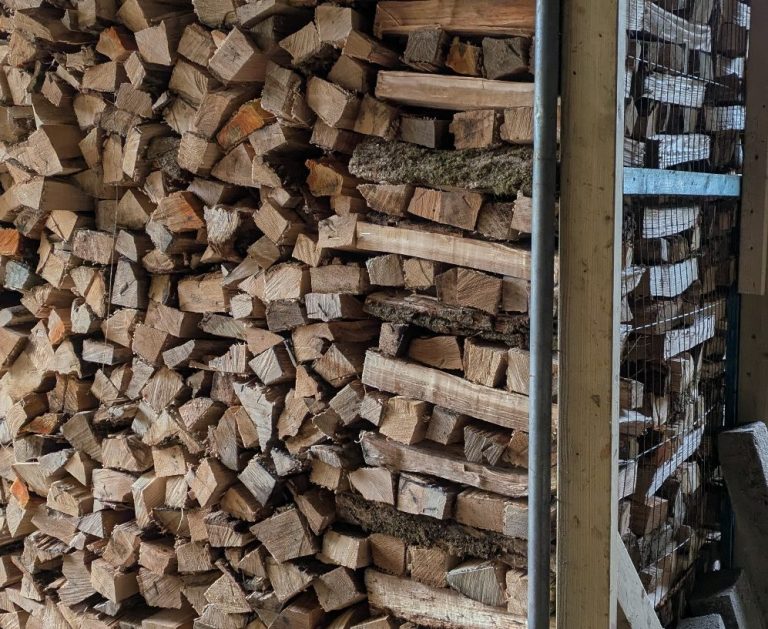
- Once split, stack off the ground, stack it in a place that is dry and which also get lots of air moving through it. A closed barn or shed is not great and moisture will probably not leave the logs quickly enough and rot may get a hold. A proper log store will have large air slats in with double skinned walls (hit and miss fencing so to speak). Single skin sides will let rain in. Air needs to be able to move around the wood top, bottom, sides and the logs need to be kept out of the wet. If rain is able to get onto the logs, then this will hamper the drying process so consider some form of front cover to deflect any rain or snow from hitting the logs. This can be as simple as leaning a pallet against the front of the stack, or building a moveable screen with slats or [garden] mesh so that the rain hits it and is arrested on it so that the drips go down the screen and not on to the logs. Solid doors on the logstore should be avoided.
- Optimal siting of the store will enhance the drying process and unlike milled timber, direct sunshine will be a good thing to speed drying.
- Do not make your log stores too large. Consider how much you will use and how long it takes to replenish each store. Have multiple store sectors rather than 1 single large bay/store. Reason being is that you will want to replenish a store when it is empty to get max time in the drying cycle for the next load. If the storage bay is too large and it takes too long to clear, then you won’t be able to take advantage of time when you can replenish it because you will be waiting to clear the store. I can’t say how big it should be for your use, but if you use more than your storage space per burning season, then I would suggest 2 or 3 separate stacks which can be managed and replenished individually.
- Stack properly. Logs thrown into a store in a pile not only take up at least 30% more space, but also don’t dry as efficiently. Stack in rows with a couple of inches between each row. Air must be able to move through and around the logs.
That’s it. Couldn’t be simpler.
If you cut wood in the January-February time, get it in from the wood by April, cut, split and store it by June time you have a really good chance of burning wood at 15-20% moisture content by November. I would just put one big ‘except’ on that and that is that different species will dry at different rates e.g. oak, which takes a bit longer to get down to the correct moisture content, given that it is a very dense wood that doesn’t want to give up its moisture that easily. Wood such as hazel, birch, beech, sycamore, willow will usually dry well. Softwoods are a bit more hit and miss and the more resinous ones may need longer depending on species. I haven’t much experience with softwood burning except cypress – which is a good burner, but does take a long time to season - 9-12 months in optimum conditions I'd say.
There is one other important consideration which I learnt from the CAT book early on and that’s don’t have your logs too big. The length of your logs will be governed by the size of your log burner, but the max sort of width size you want (according to the CAT book) is around 4”/10cm sides. It’s a volume to surface area thing – I’ll leave you to read the detail in the book if you’re interested.
Keeping your logs too big has 2 downsides – 1) they take longer to dry, 2) They take longer to heat up in your log burner until the important vapourisation temperature. I’ve heard people say to me that they like a large log on the fire just smoldering away giving out a regular heat, but this is wasteful and means that more pollution goes up your chimney than it should do. It also leads to sooty deposites in your chimney, which are generally a bad thing. Talk to your chimney sweep.
Of course, the downsize to having them smaller is that you have to split more and handle more individual logs overall, but to counter this just remember why you’re doing it in the first place – for heat!